


Book recommendations
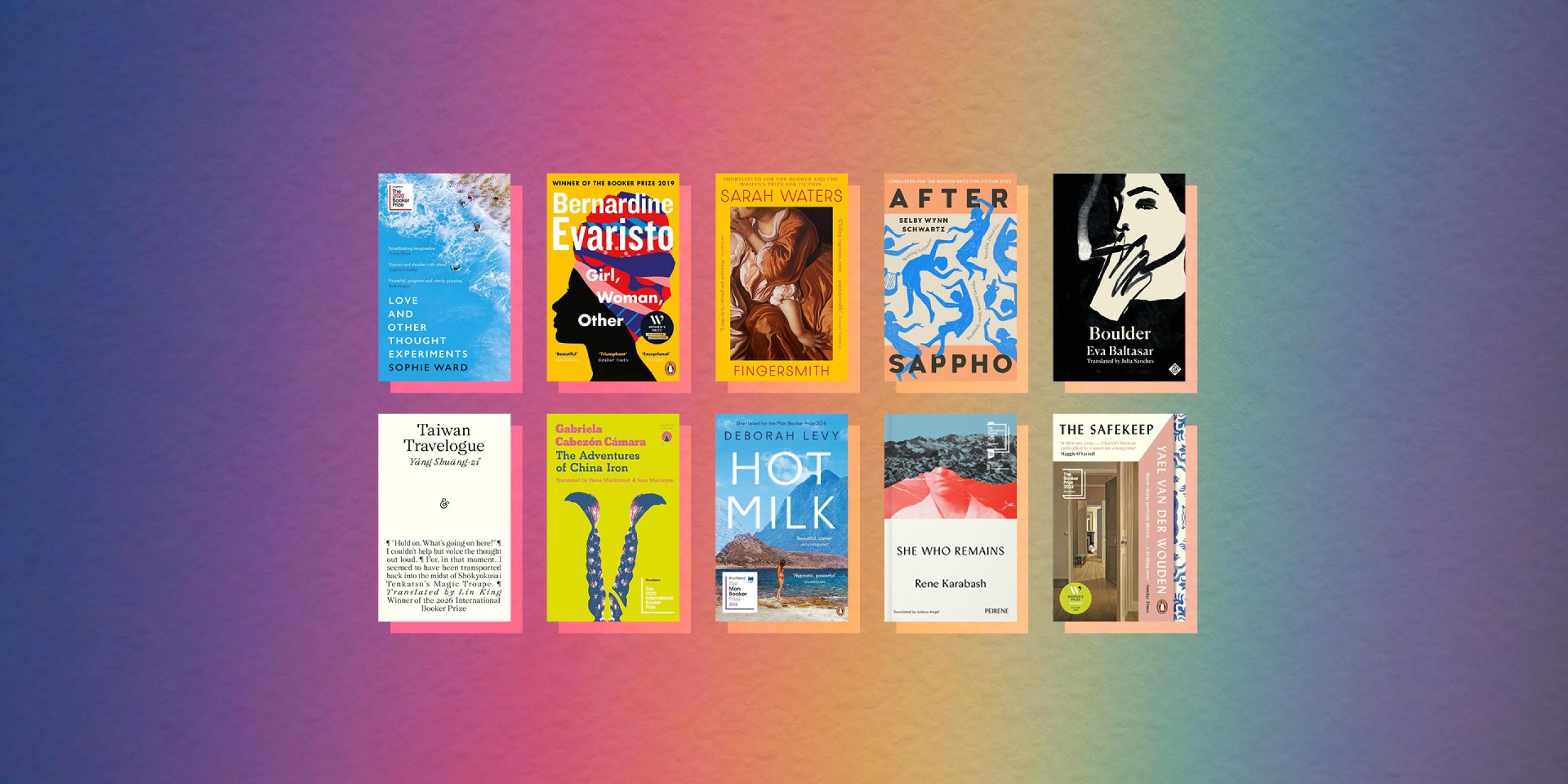
Discover some of the best sapphic love stories that have been nominated for the Booker and International Booker Prizes, with 10 intoxicating tales of self-discovery and seduction
Taiwan Travelogue, the winner of the International Booker Prize 2026, sumptuously explores the love between two women through food, language and history.
Yáng Shuāng-zǐ and Lin King’s win has prompted us to look through the Booker Library and delve into some of its best explorations of sapphic love. With Pride month just around the corner, what better time to profile these books.
From Victorian England to 1930s Taiwan – and from the Netherlands in the mid-20th century to modern-day Albania – these Booker-nominated novels don’t just span history and geography, they also chart intricate emotional depths.
When explaining why Taiwan Travelogue won the International Booker Prize 2026, Chair of judges Natasha Brown explained it ‘pulls off an incredible double feat: it succeeds as both a romance and an incisive postcolonial novel’. As the book unearths colonial histories, it also reveals, heartbreakingly, how power dynamics determine our most intimate relationships.
It’s May 1938 and a young novelist, Aoyama Chizuko, has sailed from her home in Japan to Taiwan. Invited there by the Japanese government, who are ruling the island, Chizuko has no interest in any imperialist agenda. Instead, she longs to experience real island life and sample as much of its cuisine as possible.
Soon, she meets Chizuro: the charming, erudite and meticulous woman hired as her interpreter. Chizuro arranges all of Chizuko’s travel and proves to be an exceptional cook. The story unfolds over scenic train rides, braised pork rice, sharp banter and winter melon tea. With every journey and mouthful, Chizuko grows infatuated with her companion and intent on drawing her closer.
In a review for The Conversation, Eva Cheuk Yin Li said, ‘What makes the book genuinely pleasurable… is its treatment of intimacy between the two women. The queer undertow is rendered through the minute economies of shared meals and unfinished sentences, through which Yáng smuggles the most profound questions about desire, friendship and colonial entitlement into the everyday.’
Sophie Ward weaves a beguiling web of fable and fiction, fate and folly, fact and philosophy, over 10 interconnecting but self-contained chapters.
Rachel and Eliza are hoping to have a baby. The couple spend many happy evenings together planning and dreaming about the future. Then one night, Rachel wakes up screaming. She tells Eliza that an ant has crawled into her eye and is stuck there. She knows it’s mad, but she knows it’s true. Eliza thinks it might all just be a bad dream. This mania sets off a chain of events that calls their entire relationship into question.
Love and Other Thought Experiments asks, what are the limitations of reason?
When asked about the love story at the heart of her novel, Ward told the Booker Prizes: ‘Not long ago, families like Rachel and Eliza’s would have seemed impossible. The love story in the book, for me, is the way that the connections form between all the characters, and the effect they have on each other’s lives.’
Bernardine Evaristo’s Booker Prize-winning novel presents a gloriously new kind of history of Britain. It does so with vivid originality, irrepressible wit, and sly wisdom.
Girl, Woman, Other follows the stories of 12 very different people – mostly women and mostly Black – who call the UK home. Teeming with life and crackling with energy, we journey through different generations and social classes, in an ever-expanding chronicle of our times. While primarily recognised as an exploration of Black British womanhood, Girl, Woman, Other is also widely celebrated in sapphic literature circles. It features a rich tapestry of queer, lesbian, and bisexual characters whose intersecting lives redefine the modern sapphic experience.
When asked about the ‘othered’ female, Evaristo told the Guardian: ‘I wanted to put presence into absence. I was very frustrated that Black British women weren’t visible in literature. I whittled it down to 12 characters – I wanted them to span from a teenager to someone in their 90s, and see their trajectory from birth, though not linear. There are many ways in which otherness can be interpreted in the novel – the women are othered in so many ways and sometimes by each other. I wanted it to be identified as a novel about women as well.’
Selby Wynn Schwartz’s fierce and luminous book reimagines the lives of a brilliant group of feminists, sapphists, artists and writers from the past. The women battle for control over their lives, for liberation and for justice.
After Sappho is told in a series of cascading vignettes and features a multitude of feminist torchbearers from the late 19th and early 20th centuries, including Sarah Bernhardt, Colette, Eleanora Dude, Lina Poletti, Josephine Baker and Virginia Woolf, to name just a few. The book asks, what did we want? It answers: ‘we wanted what half the population had got by just being born’.
In an interview with Galley Beggar Press, Schwartz said: ‘At its heart, the book is about trying to find a shape for your life that hasn’t already been prescribed as your inevitable, cramped destiny… Its characters are a constellation of turn-of-the-century women living in Europe and the UK: as feminists, artists, and writers, they wanted to say for themselves what their genders & sexualities & artistic practices & political rights should be.
‘It’s difficult to invent a new form for yourself, so these women looked for models – and there are notoriously few, so they began to style themselves after Sappho, the legendary poet of Lesbos. In that sense, it’s also a book about being an inveterate reader.’
Another novel from this year’s International Booker Prize shortlist, She Who Remains is a dark and poetic book about identity, gender, love, freedom and societal norms.
High in Albania’s Accursed Mountains, in a village ruled by the ancient laws of the Kanun, Bekija escapes an arranged marriage by becoming a sworn virgin. She renounces her womanhood to live as a man. Her decision sets off a brutal chain of events, destroying her family and separating her from the woman she loves most.
Years later, Bekija – now Matija – tells their story to a visiting journalist. Long-buried truths come to light, along with the realisation of all that might have been.
The book was hailed by its US publisher as a ‘landmark Bulgarian queer novel’. Translator Izidora Angel said in an interview with the Booker Prizes: ‘Rene’s book – an epic story of forbidden queer love – was a major critical and commercial success in Bulgaria (and outside of it, too). But gay marriage is still banned in Bulgaria, let us not forget this. So, the conversations we have around art are, to me, just as important as the art. These conversations cannot happen if the gates are not open for literature from small countries.’
In this novel, Baltasar demonstrates her pre-eminence as a chronicler of queer voices navigating in a hostile world. Her prose is as brittle and as beautiful as an ancient saga.
Working as a cook on a merchant ship, a woman comes to know and love Samsa, who gives her the nickname ‘Boulder’. When the couple decide to move to Reykjavik together, Samsa announces that she wants to have a child. She is already 40 and can’t bear to let the opportunity pass her by.
Boulder is less enthused but doesn’t know how to say no; and so, finds herself dragged along on a journey that feels as thankless as it is alien. With motherhood changing Samsa into a stranger, Boulder must decide where her priorities lie, and whether her yearning for freedom will trump her yearning for love.
Baltasar sees herself in her creation, telling Pink News: ‘I discovered that I contained both a Boulder and a Samsa because motherhood is not a double-sided coin. It’s more complex, polyphonic, and, like all relationships, it is alive, in motion.’ Baltasar’s characters reflect the challenges contemporary women face and ‘how intense and interesting life can be when you make the choice to live on the edge’.
This is an exhilarating tale of twisted desire, histories and homes – and the legacy of one of the 20th century’s greatest tragedies.
It’s 15 years since the Second World War and the rural Dutch province of Overjjssel is quiet. Bomb craters have been filled, buildings reconstructed, and the conflict is well and truly over. Isabel lives alone in her late mother’s country home, and her life is as it should be, led by routine and discipline. All is then upended when her brother, Louis, delivers his graceless new girlfriend, Eva, at Isabel’s doorstep as a guest, to stay for the season.
Eva is Isabel’s antithesis. She goes to sleep late, wakes late, walks loudly through the house, and touches things she shouldn’t. In the sweltering heat of the summer, Isabel’s desperate desire for order transforms into a fury-fueled obsession. Van Der Wouden told the Booker Prizes that she had set out to ‘explore desire as the flipside of repulsion.’
When asked about queer identity and sexuality in an interview with the Guardian, Van Der Wouden said: ‘We don’t leave this life in the same bodies were born into, we are always under flux. This is not to say that gender and sexuality is a choice followed by change, but rather that change is an inherent part of life.’
In 1872 Argentina, China is a young woman eking out on an existence in a remote gaucho camp. After her no-good husband is conscripted, China bolts for freedom. She sets off on a wagon journey through the pampas in the company of her new-found friend Liz, a settler from Scotland.
The Adventures of China Iron is a subversive retelling of Argentina’s foundational gaucho epic: Martín Fierro. The novel is a celebration of the colour and movement of the living world, the open road, love and sex, and the dream of lasting freedom.
On writing the novel, Cámara told the punch magazine: ‘When I had the idea of writing the life story of China — it wasn’t simply an idea, it felt like a joyful burst of laughter in my body — I knew straight away that I wanted China to have a luminous life, worlds away from the kidnapping, humiliation and never-ending oppression that blights the life of her poor ex-husband, Martín Fierro.
‘I thought, and felt, that her destiny just had to be full of light, like the grasslands of the pampa, like that of people who are lucky enough to reach great heights after having hit rock bottom. Sexual discovery and personal liberation are, undoubtedly, a very important part of any life worth living.’
In this novel, Deborah Levy explores the strange and monstrous nature of womanhood and relationships, in this hypnotic tale of sexuality and power.
Two women arrive in a village on the Spanish coast. Rose is suffering from a strange illness that has left doctors mystified. Her daughter, Sofia, has brought her to Spain to find a cure with the infamous and controversial Dr Gomez. He is a man of questionable methods and motives. Sofia soon meets Ingrid, a formidable German seamstress who exudes confidence, and the two women embark on a passionate affair.
In the London Review of Books, Alice Spawls writes: ‘It’s not simply a sexual experiment – there’s lots of sex in Levy’s work, but it’s rarely just about sex (although as Sofia admits, “my own sexuality is an enigma to me”).
‘Ingrid might be a way of learning to be braver, a way of illuminating something: “Ingrid’s body is a naked light bulb, and I am a dark room.” She appears like a hero in silver sandals, laced up high. “She looked like she had been adorned with treasure.” In ancient Rome, the higher the sandal was laced, the higher the rank of the fighter. In Sofia’s new constellation, Ingrid is the warrior.’
Waters’ signature blend of intriguing mystery and suspense is ever present in this evocative Victorian underworld page-turner. Secrets and betrayal pulsate throughout the novel.
The city is London and the year is 1862. Sue Trinder, orphaned at birth, grows up under the rough but loving care of Mrs Sucksby and her family of unwanted babies turned artful dodgers, ‘fingersmiths’.
One of Mrs Sucksby’s scams places Sue as a lady’s maid to an orphan heiress in a sprawling Gothic mansion. This is a catalyst for the narrative to explore even darker corners, among the pinched corsets and rustling skirts of Victorian England.
Fingersmith is regarded as a novel that celebrates plot and its pleasures. It looks to the past but, by imagining alternative histories, it also begins to rethink the present and the future. With giddiness, naughtiness, courage and mischief… of course.
In an interview with the Guardian, Waters said, ‘For somebody like me, looking to the past for evidence of queer lives and finding, in mainstream sources, only hints, fragments and gaps, this male-authored pornography has always been oddly attractive: it’s the one area of Victorian representation where you’re guaranteed to find lesbians having a good time.
‘As I was putting Fingersmith together, I began to wonder how it would be to depict 19th-century women enjoying porn on their own terms – say, by extracting the queer content from a larger narrative, then discarding the rest.’


