


The Handmaid's Tale
by Margaret Atwood
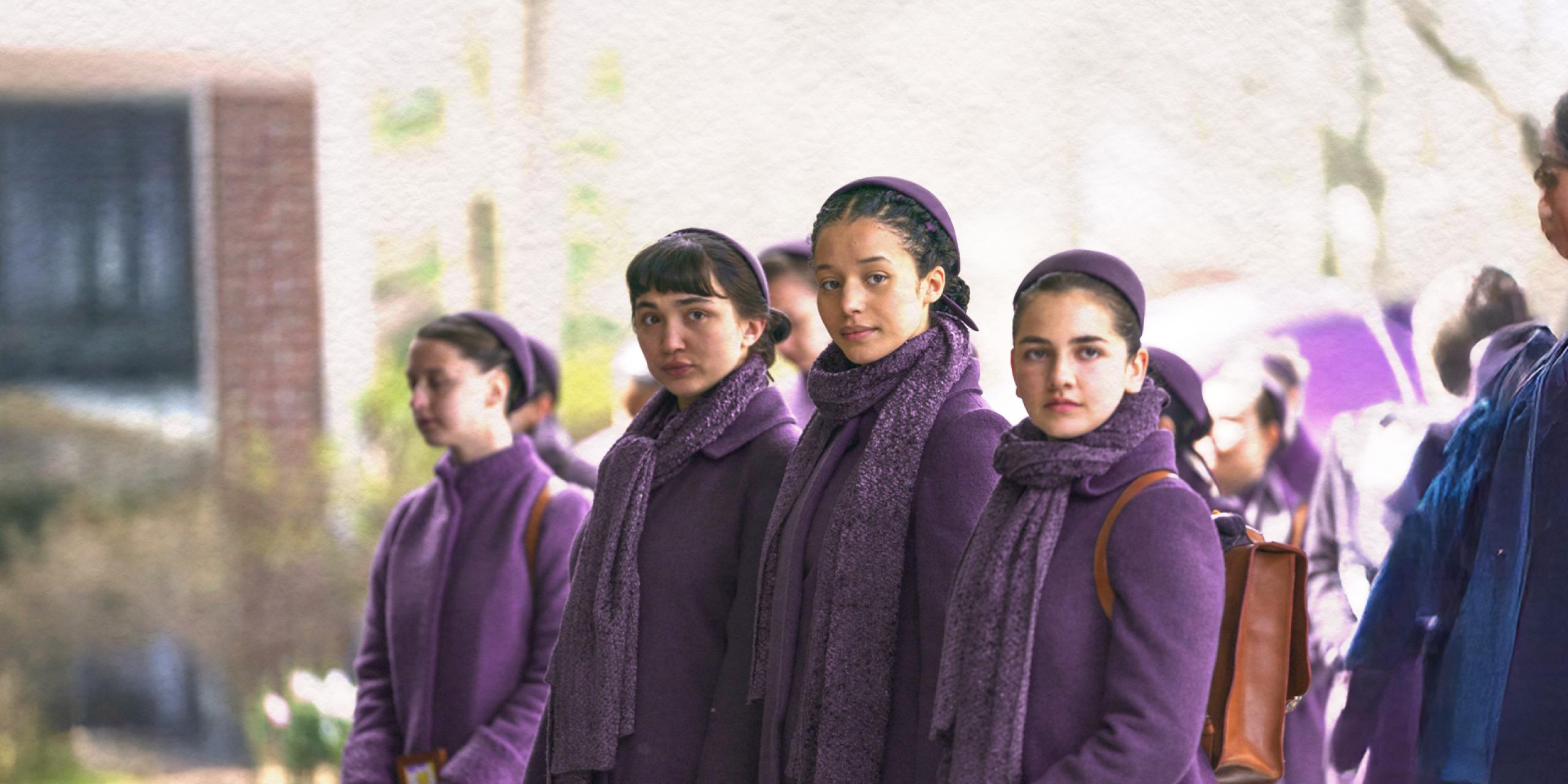
As a new TV series adapted from Margaret Atwood’s Booker Prize-winning novel hits our screens, here is our comprehensive guide to The Testaments – whether you’re new to the book or would like to explore it more deeply
More than 15 years after the events of The Handmaid’s Tale, the theocratic regime of the Republic of Gilead maintains its grip on power, but there are signs it is beginning to rot from within. At this crucial moment, the lives of three radically different women converge, with potentially explosive results.
Two have grown up as part of the first generation to come of age in the new order. The testimonies of these two young women are joined by a third: Aunt Lydia. Her complex past and uncertain future unfold in surprising and pivotal ways.
The Testaments was joint winner of the Booker Prize in 2019. A TV adaptation of the novel – starring Chase Infiniti as Agnes, Lucy Halliday as Daisy and Ann Dowd as Aunt Lydia – premiered on Disney+ in April 2026.
Aunt Lydia
Aunt Lydia is a returning character from The Handmaid’s Tale. She is a formidable force, training and punishing the handmaids. In The Testaments, she reveals her true alliance to the resistance against Gilead and plans the government’s downfall from within its highest ranks.
Agnes Jemima
Agnes Jemima is the adopted daughter of Gilead Commander Kyle and his wife Tabitha, enjoying a privileged and comfortable lifestyle. But after a series of tragic events, she chooses to become an Aunt in training, called a Supplicant, to avoid marrying a Commander. While at the Aunts’ training facility, Ardua Hall, Agnes Jemima befriends Daisy and they work together to attempt to bring down the government.
Daisy
Living in Canada with her parents, 16-year-old Daisy is unaware of her true identity. After her parents are killed, she discovers she was adopted and smuggled out of Gilead as a baby. Daisy is recruited into the resistance and participates in a mission to retrieve secret documents that could destroy Gilead.
The Testaments, season 1
© MovieStillsDBMargaret Atwood is the world-renowned, multi-award-winning author of more than 50 books of fiction, poetry and critical essays. She has also worked as a cartoonist, illustrator, librettist, playwright and puppeteer. Her novels include Cat’s Eye, The Robber Bride, Alias Grace, The Blind Assassin and the MaddAddam trilogy.
Atwood’s 1985 classic The Handmaid’s Tale was shortlisted for the Booker Prize in 1986. It was followed in 2019 by a sequel, The Testaments, which was a global number one bestseller and won the Booker Prize.
It was Atwood’s sixth Booker Prize nomination and her second win. The Blind Assassin was awarded the Booker Prize in 2000. She was also shortlisted for The Man Booker International Prize in 2005 and 2007 for her entire body of work.
In 2025, Atwood published a memoir: Book of Lives: A Memoir of Sorts.
Author Margaret Atwood posing for a portrait in Toronto, Canada.
©Associated Press/Alamy
Peter Kemp, The Times
‘Shrewdly, instead of weakening The Handmaid’s Tale’s assured status as a horror-paradigm of ideological tyranny by stretching out its fearfulness, Atwood has complemented her menacing masterpiece with a mordantly entertaining look at the monstrosities of Gilead on the brink of its dis-integration.’
Michiko Kakutani, New York Times Book Review
‘Atwood’s sheer assurance as a storyteller makes for a fast, immersive narrative that’s as propulsive as it is melodramatic … Atwood wisely focuses less on the viciousness of the Gilead regime (though there is one harrowing and effective sequence about its use of emotional manipulation to win over early converts to its cause), and more on how temperament and past experiences shape individual characters’ very different responses to these dire circumstances.’
Ron Charles, The Washington Post
‘The Testaments opens in Gilead about 15 years after The Handmaid’s Tale, but it’s an entirely different novel in form and tone. Inevitably, the details are less shocking … Atwood responds to the challenge of that familiarity by giving us the narrator we least expect: Aunt Lydia. It’s a brilliant strategic move that turns the world of Gilead inside out.’
Constance Grady, Vox
‘The Testaments is a hopeful book. It’s escapist. It’s a thriller. It’s a bit of a joyride … she holds on to the central belief of the TV show, which is that Gilead is a dystopia with hope, that it will be destroyed by individual and extraordinary human beings.’
Barbara VanDenburgh, USA Today
‘The Testaments is worthy of the literary classic it continues. That’s thanks in part to Atwood’s capacity to surprise, even writing in a universe we think we know so well. And she starts by making us root for dastardly Aunt Lydia … Atwood is patient in unpacking Aunt Lydia’s intentions and executing her plan, and does so with a dash of keen mordant wit.’
The Testaments, season 1
© MovieStillsDB‘I’m old enough to have lived through the major totalitarianisms and seen them at the end of, and the mid 20th century. Then other ones came along, and we’ve got some with us to this very day and other countries that went through a period of liberation and democracy after the collapse of the Soviet Union, but are now going back towards very autocratic forms of government. So I’m interested in how they get in; why people are enthusiastic about them, usually at the beginning. And then how they crumble. What brings them down? So The Testaments is not the beginning of Gilead, it’s along towards a middle-and-already-corrupt period. And we say the beginning of the crumbling. So crumbling can happen when the curtain is drawn back and you realize that what you’ve been told is not true.’
‘I started thinking about the book in 2015 and that stage is always, am I going to do this, am I not going to do this. And I note that I wrote a note to my publishers in February of 2017 saying, this is the book, so in The Testaments, I was interested in a couple of things. How she (Aunt Lydia) got that way and also how regimes crumble, how regimes like that fall apart.’
The Testaments, season 1
© MovieStillsDBThe Testaments was published 34 years after The Handmaid’s Tale, which was shortlisted for the Booker Prize in 1986. What similarities and differences did you find between the first book and its Booker Prize-winning sequel? How have the situation and characters evolved? And what changes in the real world may have influenced the differences between the two books?
The Handmaid’s Tale concentrates on Handmaid Offred’s story, ending on a cliffhanger in which her fate is left undecided. But Offred only makes a brief appearance in The Testaments, with readers left to piece together her story through other character’s perspectives. Why do you think Margaret Atwood relegated Offred to a minor character in this book and chose not to explore her story more?
The Testaments is written from three alternating viewpoints, those of Aunt Lydia, Agnes Jemima and Daisy, with the women each offering us their personal account of what’s happened. What is the effect of having three different versions of events? What did you find unique and interesting about each character’s perspective?
Atwood said in an interview with Paul Waldie from the Globe and Mail that a biography of Thomas Cromwell, Henry VIII’s ruthless chief minister, served as one inspiration for The Testaments, helping her explore how people attain positions of power. Hilary Mantel’s Booker Prize 2009 winning novel Wolf Hall depicts the rise of Cromwell. If you’ve read Wolf Hall, can you see how Thomas Cromwell’s life and character might have influenced The Testaments?
Aunt Lydia reflects that, ‘You’d be surprised how quickly the mind goes soggy in the absence of other people. One person alone is not a full person: we exist in relation to others. I was one person: I risked becoming no person.’ Do you agree? What does The Testaments reveal about isolation and community?
Atwood has long been called a feminist writer, due to her extensive exploration of women’s lives and rights within her work. But in an interview with Emily Ackew for ABC News, Atwood said that was too simplistic, explaining that ‘I am interested in who gets a say, who gets to make the laws, who doesn’t get to make the laws.’ Ackew states that, ‘For Atwood, power, not gender, is the key to Gilead.’ After reading the book, do you agree?
Daisy’s true identity is revealed in Part VIII of The Testaments. She is seen as a symbol of resistance for those seeking escape from the regime. Did you notice any earlier hints that suggested this twist was coming or was it a surprise? How did the revelations about Daisy’s biological parents change things for you as a reader?
At the end of the novel a series of letters, N, A, G, V and AL are found carved into a windowsill in Roosevelt Cottage. The cottage once served as a centre for refugees who had escaped from Gilead. Professor Pieixoto, a scholar of Gileadean Studies, gives a presentation in which he argues the letters could have been carved by Agnes Jemima and Daisy and may be the initials of all the main characters in the book. Why do you think Atwood included this detail and do you think Pieixoto’s assumption is correct?
At the end of The Testaments, Lydia says ‘Goodbye, my reader. Try not to think too badly of me, or no more badly than I think of myself.’ In an interview with Time, Atwood said, ‘Let Aunt Lydia speak for herself, and make up your own mind.’ After discovering the moral complexities of Aunt Lydia’s character, what did you make of her by the end of the book?
Daisy is reunited with both Agnes Jemima and her biological mother at the end of The Testaments. Some readers have questioned this fairy-tale ending, believing it to be rushed and too different from the sombre tone of The Handmaid’s Tale. What did you think of the way The Testaments ends? Was the conclusion satisfying? Did you enjoy the sequel’s different, more positive tone, or did you find it jarring?
The Testaments, season 1
© MovieStillsDBWinner The Booker Prize 2019


